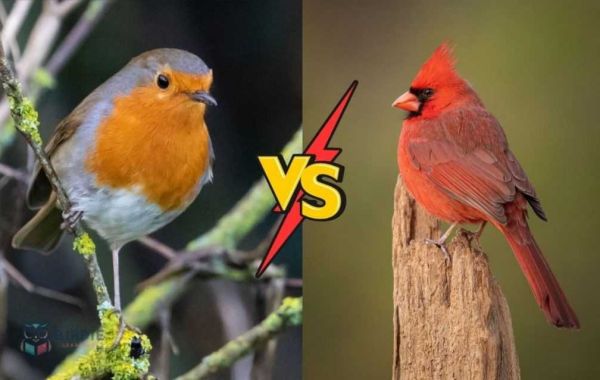

The Nesting Mystery: Decoding Your Backyard Discovery
Let's be real. There's a special kind of magic that happens when you stumble upon a tiny nest in your backyard hedge or hanging basket. You become an instant, low-key wildlife documentarian. But then comes the big question: Who is building this home? Is it the bright-breasted American Robin Bird we all love to see yanking worms out of the lawn, or is it the striking crimson of the Northern Cardinal?
While the adult birds are easy to spot (the dazzling red of the male and the lovely, muted tones of the female cardinal are dead giveaways), their eggs can look surprisingly similar at first glance. But just like decoding a tricky piece of legacy code, there are key attributes that make identification easy. You don't need a PhD in Ornithology just this quick-start guide to confidently settling the great Robin vs Cardinal egg debate!
It All Comes Down to Color: The Famous Blue
If you've ever heard the phrase "Robin's egg blue," you already know the single biggest clue.
The American Robin produces eggs that are famously, spectacularly blue. This isn't a pale blue, a speckled blue, or a bluish-white. It’s a pure, unblemled, turquoise-like color often called cyan. This vibrant, uniform hue is so distinctive it became a color name in its own right Robin egg blue. If you peer into a nest and see a clutch of smooth, brilliant blue or greenish-blue eggs, you can almost guarantee you’ve got an American Robin mom-to-be on your hands.
Now, let's look at the other side of the yard. The female cardinal bird lays eggs that are a completely different ballgame. Cardinal eggs are generally an off-white, grayish, or pale greenish base color. The critical distinguishing feature is the speckling. They are heavily marked with spots, blotches, or squiggles that are typically brown, gray, or purple. They are never a uniform, vivid blue.
Size and Shape: Tiny Details Matter
Once you have a handle on color, the next diagnostic tool is size and shape. While you should never handle or remove eggs, you can absolutely observe their relative scale in the nest.
- Cardinal Eggs: Generally smaller than robin eggs. They measure about $1$ inch long. They have an oval, slightly pointed shape, much like a traditional chicken egg (but, you know, miniaturized).
- Robin Eggs: These are noticeably larger, typically measuring around $1.2$ They are a little plumper and rounder than the cardinal's eggs. The sheer size difference, combined with the intense color, makes them easy to spot.
Nest Location: Where Did the Birds Put the Work?
The kind of home the parent birds choose to build also offers a huge clue. Thinking about where a bird chooses to put Robin Bird or Cardinal eggs can tell you a lot about the bird itself.
- The Cardinal Nest: The Northern Cardinal is a privacy enthusiast. Their nests are usually well-hidden in dense shrubs, thick vines, or low trees. They prefer to be out of sight, often constructing their nests lower to the ground than a robin. You might find them in thick rose bushes or a dense lilac.
- The Robin Nest: Robins are much bolder and often build their mud-lined nests in more obvious, sheltered spots. They love wide, stable surfaces like the crooks of tree limbs, window ledges, or under the eaves of your garage. They aim for stability and a slight height advantage over predators.
A Post-Hatching Bonus: Knowing the Sounds
Once the little ones hatch, you won't need to look at eggs anymore you'll use your ears! While this is after the egg phase, knowing the parents' cardinal sounds and Robin sounds can help you confirm your initial egg identification.
If you start hearing that famous 'cheerily, cheer up, cheer up' call, you've got the robin. If you hear the more distinct, often two-parted 'what-cheer, what-cheer' or a sharp, metallic chirp, you're listening to the northern cardinal sounds of the proud parents. And if you’re looking to keep that stunning male and female cardinal pair around, make sure you've got plenty of sunflower seeds in your cardinal bird feeders!
Your Next Step: Enjoy the View
Identifying the eggs is a wonderful first step in getting to know your feathered neighbors. Whether you’ve got the vibrant Robin egg blue staring back at you or the speckled, quiet beauty of a cardinal clutch, the discovery is the same: you have a front-row seat to the magic of nature.
Remember to keep your distance, minimize disturbance, and simply enjoy the show. Your backyard is a thriving ecosystem, and you're now an official expert in its tiny, colorful treasures!